

In today's world, there's an financial concept called Compound interest which very world's greatest investors including Warren Buffett or Peter Lynch consider Compounding as one of the most powerful forces in finance which help ordinary people to build extraordinary wealth. Through this Blog, We will understand how to maximize your wealth using Compound Interest from a Gen-z Founder perspective.
The best part is? You don't need to be rich to use it.
Compound Interest rewards
- patience
- consistency
- long-term thinking
Let's start
What is Simple vs Compound Interest?
Before understanding compounding deeply, it’s important to know the difference between simple interest and compound interest.
What is Simple Interest?
Simple interest is calculated only on the original amount (principal) you invest.
Formula:
Simple Interest= P x R x T/ 100
Where
- P = Principal amount
- R = Rate of interest
- T = Time
For Example: You invest ₹10,000 at 10% simple interest for 3 years.
Every year interest is ₹1,000
After 3 years,
- Total interest = ₹3,000
- Final amount = ₹13,000
In Simple terms, your money will grow at a constant rate or fixed rate.
What is Compound Interest?
Compound interest works differently. You earn interest on your original money and previously earned interest.
That is why Compounding grows wealth faster over time.
Formula:
A = P (1+R/N)NT
Where:
- A = Final amount
- P = Principal
- R = Interest rate
- N = Number of times compounded yearly
- T = Time
Example:
You invest ₹10,000 at 10% compound interest.
Year 1: ₹10,000 → ₹11,000
Year 2:
- Interest is calculated on ₹11,000
- Amount becomes ₹12,100
Year 3:
- Amount becomes ₹13,310
Notice: Compound interest gives more returns because interest keeps building on itself.
Why Compound Interest is So Powerful?

Compound interest becomes powerful because of time.
In the beginning, growth looks small.
But after many years, growth accelerates rapidly.
This is called the snowball effect.
Small money + Long time = Large wealth
That’s why people who start investing early often become financially stronger later.
For Example: Warren Buffett is the prime example as he gained his 99% wealth after crossing 50 years.
How Often is Interest Compounded?
Compounding frequency matters because the more often interest is added, the faster wealth grows.
Interest can be compounded
- Yearly
- Half-yearly
- Quarterly
- Monthly
- Daily
Example of Different Compounding Frequencies
Suppose you invest:
- ₹1,00,000
- At 10% annual interest
If compounded yearly: You earn interest once a year.
If compounded monthly: Interest is added every month.
Note: Monthly compounding gives slightly higher returns than yearly compounding.
The difference may seem small initially, but over many years it becomes significant.
What Does It Mean if Interest is Compounded Continuously?
Continuous compounding is an advanced form of compound interest where interest is added to your investment every possible moment instead of at fixed intervals like yearly, monthly, or daily.
Normally, banks or investments compound interest:
- Once a year
- Every 6 months
- Every month
- Or every day
But in continuous compounding, interest is theoretically being added all the time without stopping.
Understanding It in a Simple Way
Imagine you invest ₹1,00,000 at an 8% annual interest rate.
- Yearly Compounding
Interest is added once every year.
- Monthly Compounding
Interest is added every month.
- Daily Compounding
Interest is added every day.
- Continuous Compounding
Interest is added every single moment continuously.
It means your money keeps growing every second.
Why Does Continuous Compounding Matter?
The idea behind continuous compounding is to show the maximum possible growth your money can achieve at a fixed interest rate.
The more frequently interest is added
- The faster your money grows
- The more powerful compounding becomes
Although the difference between daily and continuous compounding may look small in the short term, over many years the effect becomes noticeable.
What is Continuous Compounding Formula?
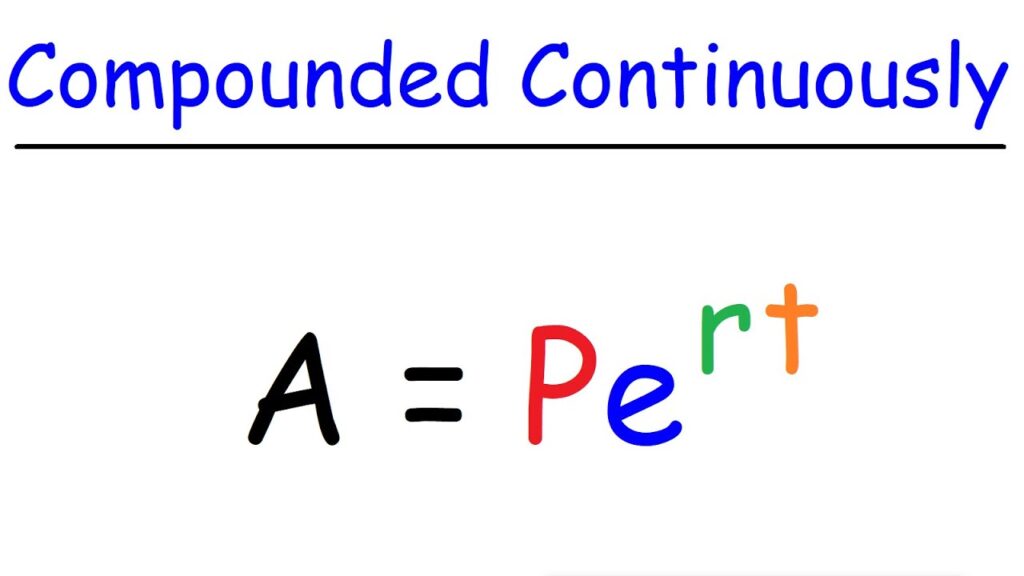
A= Pe RT
Where:
- A = Final amount
- P = Principal amount
- e = Euler’s number (approximately 2.718)
- R = Interest rate
- T = Time
Even if the formula looks advanced, the core idea is simple: The longer money stays invested, the faster it grows through compounding.
Example of Continuous Compounding Formula
Let’s understand continuous compounding with a simple example.
Given:
- Principal Amount (P) = ₹10,000
- Interest Rate (R) = 10% = 0.10
- Time (T) = 3 years
Step 1: Put the values into the formula
Step 2: Multiply the interest rate and time
So the formula becomes:
Step 3: Calculate e0.30
e0.30≈1.3499
Step 4: Final Calculation
After 3 years, ₹10,000 invested at 10% continuous compounding becomes approximately ₹13,499
How to Maximize Your Wealth Using Compound Interest
Now let’s understand how you can actually use compounding to build wealth.
1. Start Early
Time is the biggest advantage in compounding.
A person investing at age 20 usually builds far more wealth than someone starting at 30, even if the second person invests more money.
Early investing beats large investing.
2. Stay Consistent
Consistency matters more than occasional large investments.
Even small monthly investments can grow massively over time.
For Example: ₹5,000 monthly SIP invested consistently for 20 years can create significant wealth due to compounding.
3. Reinvest Your Returns
Don’t withdraw returns too early.
The more money stays invested, the more compounding works.
This is exactly how long-term investors build wealth.
4. Invest for Long-Term
Compounding becomes truly powerful after
- 10 years
- 15 years
- 20 years
Short-term investing limits the power of compounding.
5. Avoid Emotional Decisions
Many people panic during market crashes and stop investing early
This interrupts compounding.
Successful investors stay disciplined and continue investing during both good and bad times.
In Conclusion:
This is how to maximize your wealth using compound interest. Compound interest is not magic, it’s mathematics combined with patience.
It rewards people who
- Start early
- Stay consistent
- Think long-term
You don’t need huge money to build wealth.
You need:
Time + Discipline + Consistency.
We made a blog on How Financial Market Works? Do check it out which will give you insights of Financial markets or Know What is Intrinsic Value? which will make you understand why Warren Buffett used it in his philosophy.